
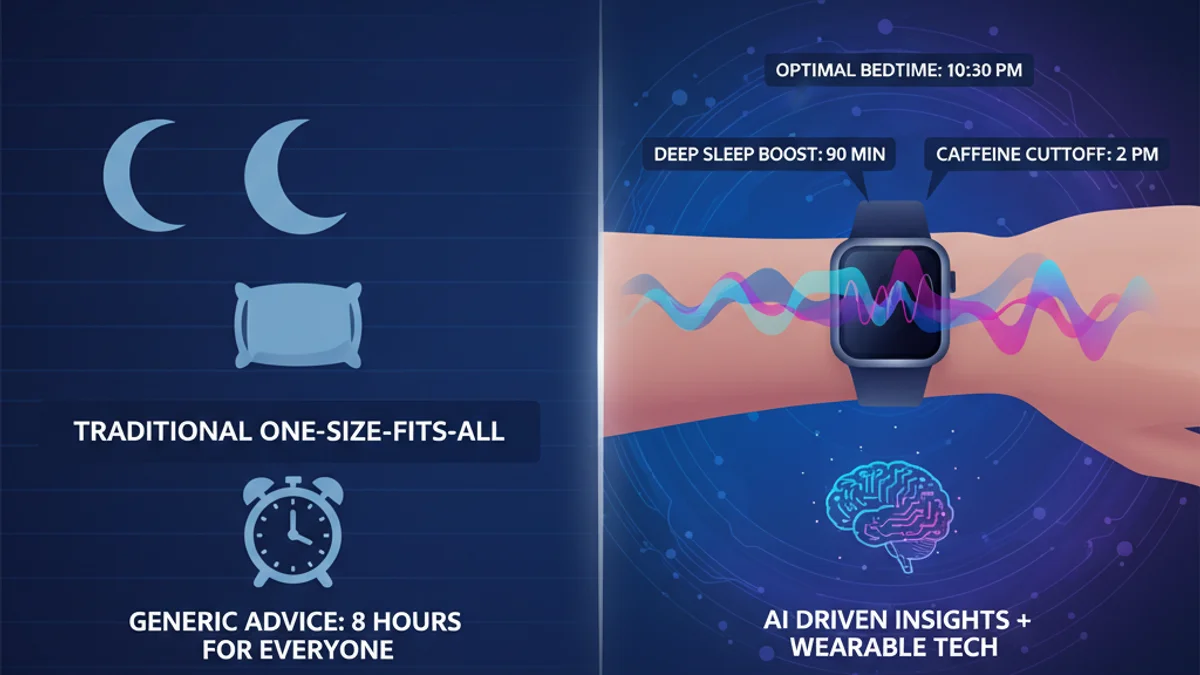
You have done what the leaflets told you - no coffee after lunch, blackout curtains closed, the window cracked open, the phone left outside the room - but also still the clock hands crawl past three. The manuals promise identical results for every brain - new work with wearables and machine learning says the opposite. In one recorded night the same late night espresso destroys half the deep sleep in person A and leaves person B untouched.
The list that never quite fits
Sleep-hygiene posters repeat the same bullet points for everyone - fixed bedtime, zero night caps, daylight exercise, soft lighting, no scrolling. Those tips are built on averages across thousands of strangers. A Mexico City pilot in 2025 couples Samsung Galaxy Watch streams to an algorithm that writes rules for only one wearer at a time. After eight weeks the tailored set beat the usual lecture on almost every score - fewer awakenings, higher oxygen saturation, lower next day fatigue. Clinicians now have numbers for what they long suspected - a snack at 23:00 can yank one sleeper out of slow wave sleep while the next tracker shows no dip at all.
What the wrist records
Smartwatches and bands collect heart beat spacing, limb motion, blood oxygen spikes, skin heat. When those columns of numbers flow into a model it links tiny earlier choices - one glass of wine, a 22:00 run - to the lost minutes of deep sleep. The UMass Amherst BIDSleep project pairs Apple Watch signals with a neural net that labels sleep stages with 71 % agreement against laboratory polysomnography, a jump over prior consumer grade attempts. The code is sharable - the device is already on the owner’s wrist.
Thousands of nights of records show that waking up at the same time each morning gives clearer energy the next day than simply staying in bed longer. Seven hours taken from midnight to seven beats eight hours that start at ten on Monday and at one on Tuesday. Heart rate variability - the gap between one beat plus the next - rises and falls in its own pattern for every person but also marks recovery more faithfully than any fixed threshold.
Food eaten close to bedtime drags on attention more than a short night for many. Swapping between tasks and juggling choices tires the mind faster than lifting or hauling. Those patterns surface only when you follow the same person week after week - averages across a crowd hide them.
The AI personalization study - Machine learning beats generic recommendations
In the Mexico City study, volunteers keep Samsung Galaxy Watches on their wrists around the clock. One group receives the usual leaflet on “sleep hygiene” - the other, daily advice built by an algorithm that has studied their own last thirty nights.
The model learns which choices ruin sleep for each wearer - one subject loses slow wave minutes whenever coffee touches lips after twelve - another pours a cup at four and still sleeps soundly. One sleeper needs lights out within a five minute window - a second feels rested even when bedtime wanders.
After eight weeks, the tailored group scores higher on morning questionnaires for mood, focus and willingness to stick with the plan. Advice hits home when it names the reader’s own trigger, not a stranger’s.
The same rule guides our Sofia office: record EEG first then pick the AVE frequency set. A stock playlist gives stock results. Whether the guide is an AI sorting wristband data or an amplifier reading cortex waves, the goal is the same - show the pattern that must shift for this brain alone.
Sleep consistency beats duration - Surprising findings about what predicts energy
The watch data back a long standing claim in sleep labs - the clock matters more than the hour count. The head that meets pillow at eleven or rises at six seven days in a row outscores the head that logs eight hours swinging from ten to one.
Fixed bedtimes anchor circadian timekeepers - the brain’s clock needs predictable light, food and temperature signals to dispatch melatonin, drop core heat next to open the gate for deep wave sleep. Shift bedtime by sixty minutes or more and the sequence frays - melatonin lags, cortisol fires early plus the deepest portion of the night compresses into a narrow slot.
Sleep stages shift with routine - a schedule that jumps around yields more light sleep and cuts the deep besides REM phases the body needs for repair. Heart rate variability falls, a sign the nervous system remains on alert. Those changes stick even when the night adds up to enough hours.
For people dealing with insomnia this insight offers a clearer target than vague advice to sleep more. Locking in a fixed bedtime and wake time - even on weekends - stabilizes the system faster than most other interventions. When we prescribe AVE therapy for insomnia we always emphasize schedule consistency alongside the sessions because both work together to reset disrupted sleep cycles.
How personalization works at 6th - EEG assessment driving custom AVE protocols
At 6th the order is measure first, tailor second - the same sequence wearables proved. At our Sofia office, every session follows a structured process: first a two-minute EEG measurement with a Muse headband, then an AVE session with a Roxiva lamp and headphones, and finally another two-minute EEG measurement. The recording captures key metrics such as alpha peak, alpha asymmetry, EEG entropy, and alpha power - markers tied to depression, anxiety, and sleep quality.
From this data we calculate our proprietary EEG Index™ - a system that links EEG metrics to the patient’s psychological state. The index allows us to select the most appropriate AVE program for the next session and track progress objectively.
We watch change with two measures. The Session Improvement Index tracks the difference in EEG index before and after each session - it shows the immediate effect of that specific procedure. The Baseline Index tracks changes in the EEG index over time - it shows long-term improvement across the full protocol of 10-15 sessions. The first shows whether a session was effective, the second shows whether the protocol is rewriting the night rhythm permanently.
The 6th Mind app carries a lighter version to the handset - no electrodes are possible - the code leans on answers from daily check ins and on heart rate data pulled from the phone camera. It stores what timing or mixture cut the time-to-sleep number then edges the next session a notch in that direction.
Actionable insights - What the data consistently shows across individuals
Across wristbands, clinical charts and our own files, the pattern repeats unchanged. A fixed wake up hour returns more rest per minute than any pill, herb or lamp. Target a window no wider than thirty minutes, weekends included.
Evening light matters - Light after eight o’clock tells the brain to wait on melatonin. Swap bright lamps for low bulbs or put on amber lenses during the last two hours before bed. Step outside within half an hour of waking - daylight locks the body clock in place.
Caffeine lingers - The body needs five or six hours to clear half of what you drank. A cup at four in the afternoon still leaves a quarter of the stimulant in the blood at midnight. A last cup at noon suits most people - others learn their own cut off by trial.
Alcohol is not a sleep help - A drink shortens the time to the first unconscious moment but it chops the night into fragments and starves the brain of REM. One glass is enough to scramble heart rhythms plus change the map of sleep stages.
Temperature drives sleep onset - The core must fall for the brain to switch to sleep. A hot bath ninety minutes before bed forces a quick drop when you step out - the bedroom should stay between sixteen and nineteen degrees Celsius.
Exercise timing is personal - Hard effort warms the body but also raises stress hormones. Some need four clear hours between workout and lights out - others drop off right after late reps. Log your own response as well as follow the data.
Moving beyond one size fits all approaches
Medicine is turning away from averages and toward the single patient. Sleep works the same way - start with broad rules then measure, adjust, repeat. Track nights with a ring, a headband, a notebook - whatever shows the pattern. Change one habit, record the outcome. The trick that rescues your friend’s night may wreck yours.
At 6th we record EEG in our office, pair the measurements with personal habits, and build a personalized protocol. A stock program helps a few - a plan matched to the individual’s EEG data helps nearly all. When standard tips fail, the issue is not poor discipline - the advice never fit the architecture of that sleeper. Tailor, intervene - now proven by large scale wearable studies.
Sources
- “Machine learning-driven personalized sleep recommendations from Samsung Galaxy Watch data outperform generic sleep hygiene advice” - PMC, 2025
- “AI enabling clinical-grade wearable-based sleep tracking” - Diagnostics World News, 2025
- “App, Apple Watch and AI: UMass Amherst creates new way for researchers to study sleep health” - UMass Amherst News, 2025